

Custom WordPress roles allow you to control exactly what users can and cannot do on your WordPress website. While WordPress provides several default roles, such as Administrator, Editor, Author, Contributor, and Subscriber, those roles may not always match the specific responsibilities of your users.
For example, you may want a user who can edit posts but cannot publish them, or a team member who can manage WooCommerce products without accessing your website’s plugins and settings.
That’s where custom WordPress roles become useful.
In this guide, you’ll learn what custom WordPress roles are, how WordPress roles and capabilities work, when you should create a custom role, and the different ways to manage custom user permissions safely.
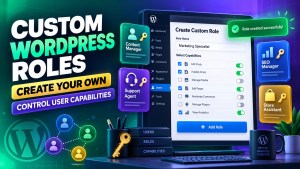
What Is a Custom WordPress Role?
A custom WordPress role is a user role created or modified specifically for the needs of your website.
Instead of relying only on WordPress’s predefined roles, you can create a role containing a specific combination of capabilities.
For example, you could create a role called SEO Manager with permissions to:
- Edit posts
- Edit pages
- Manage categories
- Upload media
- Manage SEO-related settings
while preventing the user from:
- Installing plugins
- Changing themes
- Managing administrators
- Changing critical WordPress settings
This gives you more control over user access.
The basic concept is:
Custom Role → Assigned Capabilities → User Permissions
A custom role does not automatically create a completely new type of WordPress user. Instead, it provides a specific collection of capabilities that can be assigned to users.
Why Use Custom WordPress Roles?
The default WordPress roles are suitable for many websites, but larger or more specialized websites often need more precise permissions.
Custom roles can help you follow the principle of least privilege: users should receive only the permissions they need to perform their responsibilities.
Better User Access Control
Instead of giving someone Administrator access simply because they need one additional permission, you can create a role specifically for their job.
For example:
Incorrect approach:
Give an SEO employee Administrator access because they need to edit website content.
Better approach:
Create an SEO Manager role with only the required content and SEO capabilities.
Improved Website Security
Every unnecessary permission increases the potential impact of a compromised account or accidental action.
Restricting administrative privileges can therefore reduce unnecessary exposure.
Easier Team Management
Custom roles make it easier to manage multiple users with the same responsibilities.
For example, if you have five content reviewers, you can create one Content Reviewer role and assign it to all five users.
If the permissions need to change later, you can modify the role rather than manually configuring every user.
WordPress Roles vs. Capabilities
To understand custom WordPress roles, you need to understand the difference between roles and capabilities.
A role is a collection of capabilities.
A capability is a specific permission that determines whether a user can perform a particular action.
For example, a role might contain capabilities related to:
- Reading content
- Editing posts
- Publishing posts
- Deleting posts
- Editing pages
- Uploading files
- Managing categories
- Managing users
- Installing plugins
Think of a role as a permission package.
For example:
Content Reviewer
→ edit_posts
→ edit_pages
→ moderate_comments
But not:
→ publish_posts
→ install_plugins
→ manage_options
This distinction is fundamental when designing custom WordPress permissions.
Custom Roles vs. Default WordPress Roles
WordPress includes several standard roles, but custom roles allow you to go beyond those predefined permission sets.
| Role Type | Purpose | Flexibility |
|---|---|---|
| Administrator | Complete site management | Low |
| Editor | Content management | Medium |
| Author | Publish own posts | Medium |
| Contributor | Write content for review | Medium |
| Subscriber | Basic account access | Low |
| Custom Role | Specific business requirements | High |
The main advantage of a custom role is precision.
Instead of choosing the closest default role, you can build a permission set around the user’s actual responsibilities.
When Should You Create a Custom WordPress Role?
You should consider creating a custom role when none of the default WordPress roles provides the right combination of permissions.
Common examples include:
- SEO managers
- Content reviewers
- WooCommerce product managers
- Customer support staff
- Marketing teams
- Freelance writers
- Website clients
- Membership managers
- Editors with restricted access
- Contributors who need additional capabilities
For a small personal blog, default roles may be sufficient.
For a large website with multiple teams, custom roles can make user management much more efficient.
Examples of Custom WordPress Roles
The best custom role depends on how your website operates.
SEO Manager
An SEO Manager might need to edit content and manage SEO information without having access to sensitive technical settings.
Possible capabilities could include:
- Edit posts
- Edit pages
- Upload media
- Manage categories
- Manage tags
- Access approved SEO functions
They may not need:
- Install plugins
- Activate plugins
- Edit themes
- Manage users
- Modify core settings
Content Reviewer
A Content Reviewer could review articles before publication.
Possible capabilities:
- Read posts
- Edit posts
- Edit pages
- Review submitted content
You could deliberately exclude publishing or administrative capabilities if your workflow requires final approval from an Editor.
Product Manager
An online store might need employees who manage products without having complete WordPress administrative access.
A Product Manager role could be designed around capabilities related to:
- Products
- Product categories
- Inventory
- Product media
Additional permissions could be provided depending on the e-commerce system being used.
Client Role
A web agency may create a custom role for clients.
For example, a client might be allowed to:
- Edit their pages
- Review content
- Upload images
while being prevented from:
- Installing plugins
- Changing themes
- Managing other administrators
- Changing critical website settings
This can make handing a website over to a client much safer.
How to Create a Custom WordPress Role
There are several ways to create a custom WordPress role.
The three most common approaches are:
- Using a WordPress role-management plugin
- Using custom PHP code
- Using a custom plugin developed specifically for your website
The best method depends on your technical experience and the complexity of your permission system.
Creating Custom Roles With a Plugin
For non-developers, a WordPress role-management plugin is often the simplest approach.
These plugins generally provide an interface where you can:
- Create a new role
- Give the role a name
- Select capabilities
- Remove unnecessary capabilities
- Assign the role to users
- Modify permissions later
This approach eliminates the need to write PHP manually.
However, you should carefully review the capabilities before saving changes.
Giving a role too many permissions can effectively turn it into an Administrator-equivalent role.
Creating Custom Roles With PHP
Developers can create custom WordPress roles programmatically.
WordPress provides functions for working with roles and capabilities, including add_role().
A simplified example looks like this:
add_role(
    'content_reviewer',
    'Content Reviewer',
    array(
        'read' => true,
        'edit_posts' => true,
        'edit_pages' => true,
    )
);
This example creates a role called Content Reviewer and assigns selected capabilities.
In a real website, you should carefully determine the exact capabilities required rather than copying permissions from an Administrator role.
You should also avoid placing permanent role-management logic directly into a theme when a dedicated plugin is more appropriate.
How to Add Capabilities to a Custom Role
You can also modify an existing role by adding or removing capabilities.
For example, WordPress’s get_role() function can retrieve a role so that its capabilities can be modified.
A simplified example:
$role = get_role( 'content_reviewer' );

if ( $role ) {
    $role->add_cap( 'edit_pages' );
}
The important principle is to grant only the capability required for the user’s job.
How to Remove Capabilities From a Role
Custom roles are not only about adding permissions.
You can also remove capabilities that users do not need.
For example:
$role = get_role( 'content_reviewer' );

if ( $role ) {
    $role->remove_cap( 'publish_posts' );
}
This can be useful when you want a user to edit content but require another person to approve and publish it.
How to Assign a Custom Role to a User
After creating a custom role, you can assign it to a user through WordPress user management.
A typical workflow is:
Users → All Users → Select User → Change Role → Update User
The exact interface can vary depending on your WordPress version and installed plugins.
Once the role is assigned, the user’s available permissions will reflect the capabilities associated with that role.
Can You Modify Default WordPress Roles?
Yes.
WordPress roles can be modified by adding or removing capabilities.
For example, you could modify the Author role to give authors an additional capability.
However, modifying a default role should be done carefully.
If you change a role globally, every user assigned to that role may be affected.
For that reason, creating a separate custom role is often a better solution when only a specific group of users needs different permissions.
Should You Modify a Default Role or Create a Custom Role?
This depends on your requirements.
Modify a Default Role When:
- The change should apply to every user with that role.
- The permission difference is small.
- You fully understand the consequences.
Create a Custom Role When:
- Only certain users need the additional capability.
- You want a separate permission structure.
- You want to preserve the original WordPress roles.
- Your website has multiple teams or workflows.
In many cases, creating a custom role is the cleaner and safer approach.
Custom WordPress Roles and Security
User permissions should be treated as part of your website’s security strategy.
The goal isn’t to give users as many permissions as possible.
The goal is to give them exactly the permissions they need.
For example, a writer who only needs to submit articles should not necessarily have permission to:
- Install plugins
- Change themes
- Manage users
- Modify website settings
Similarly, a store employee responsible for products may not need access to WordPress’s technical configuration.
Follow the Principle of Least Privilege
The principle is simple:
Minimum necessary access = better access control.
Before assigning a capability, ask:
Does this user actually need this permission to perform their job?
If the answer is no, don’t grant it.
Common Mistakes With Custom WordPress Roles
Creating custom roles gives you more control, but poor configuration can create new problems.
Giving Too Many Capabilities
One of the most common mistakes is creating a custom role by copying Administrator permissions and removing only a few capabilities.
This can leave the user with much more access than intended.
Start with the minimum required capabilities instead.
Using Vague Role Names
Names such as:
Manager
or
User 2
don’t communicate what the role is supposed to do.
Use descriptive names such as:
- SEO Manager
- Content Reviewer
- Product Manager
- Junior Editor
- Support Agent
Forgetting About Plugin Capabilities
Plugins can introduce their own capabilities.
A custom role designed for core WordPress may therefore not automatically have the permissions needed for a particular plugin.
Always check the capabilities introduced by important plugins.
Testing Only With an Administrator Account
Administrators can access almost everything, so testing permissions while logged in as an Administrator doesn’t tell you whether your custom role is correctly configured.
Instead, test the role using a dedicated test account.
How to Test a Custom WordPress Role
After creating a custom role, test it before assigning it to your entire team.
A good testing process is:
- Create a test user.
- Assign the custom role.
- Log in as that user.
- Check the WordPress dashboard.
- Test every required action.
- Attempt actions the user should not be able to perform.
- Correct the capabilities if necessary.
- Repeat the process.
Testing both allowed and forbidden actions is important.
You want to confirm not only that users can do their jobs, but also that they cannot access functions they shouldn’t have.
Custom WordPress Roles and Plugins
Plugins can significantly change WordPress’s permission system.
For example, an e-commerce plugin, membership plugin, learning management system, or SEO plugin may introduce additional capabilities.
This means your custom role strategy should consider the entire WordPress environment rather than WordPress core alone.
Before removing a capability, determine whether a plugin or workflow depends on it.
Custom Roles in WordPress Multisite
WordPress Multisite introduces additional complexity because permissions can exist at different levels.
A site Administrator manages an individual site within the network, while a Super Admin has network-level privileges.
When creating or managing custom roles in Multisite, you should clearly distinguish between:
- Site-level permissions
- Network-level permissions
Never assume that a role designed for a single WordPress installation will behave exactly the same way in a Multisite environment.
How to Remove a Custom WordPress Role
If a custom role is no longer needed, you can remove it programmatically using WordPress’s remove_role() function.
For example:
remove_role( 'content_reviewer' );Before removing a role, check which users are assigned to it.
Users should be reassigned to an appropriate role before the old role is removed.
Otherwise, you may create unexpected permission problems.
Best Practices for Custom WordPress Roles
Follow these practices when designing your permission system.
1. Start With the User’s Job
Don’t start by asking:
Which existing role should I copy?
Instead ask:
What does this user actually need to do?
Then build the permissions around those requirements.
2. Give the Minimum Required Capabilities
Avoid unnecessary permissions.
3. Use Descriptive Role Names
Make the role’s purpose obvious.
4. Test Before Deployment
Always test new roles with a non-administrator account.
5. Review Roles Regularly
Your website will evolve.
New plugins, employees, workflows, and responsibilities can make old permission structures outdated.
Review your roles periodically.
6. Keep Documentation
For important websites, document:
- Role name
- Purpose
- Assigned capabilities
- Users assigned to the role
- Plugins requiring special capabilities
This makes troubleshooting and team management much easier.
Frequently Asked Questions About Custom WordPress Roles
What is a custom WordPress role?
A custom WordPress role is a role created specifically for your website’s requirements. It contains a selected set of capabilities that determine what assigned users can do.
Why should I create a custom WordPress role?
You should create one when the default WordPress roles do not provide the exact combination of permissions your users need.
Can I create custom WordPress roles without coding?
Yes. Role-management plugins can provide a graphical interface for creating and managing custom roles without writing PHP.
Can I create custom WordPress roles with PHP?
Yes. WordPress provides functions such as add_role(), get_role(), and remove_role() for programmatic role management.
Are custom WordPress roles safe?
They can be, provided that they are configured carefully. The biggest risk is granting unnecessary capabilities.
Can a custom role replace Administrator?
Not necessarily. A custom role can be designed to provide specific administrative capabilities, but it should not automatically receive full Administrator permissions unless there is a genuine need.
Can custom roles have different permissions?
Yes. Each custom role can contain its own combination of capabilities.
Can plugins create custom roles?
Yes. Many WordPress plugins create their own roles or capabilities to support specialized functionality.
Can I modify an existing WordPress role?
Yes. WordPress roles can be modified by adding or removing capabilities. However, remember that changing a role can affect every user assigned to it.
Final Thoughts
Custom WordPress roles give website owners much more precise control over user permissions.
The default WordPress roles work well for many websites, but they aren’t designed for every organization or workflow. When your users have specialized responsibilities, creating a custom role can provide a cleaner and more secure permission structure.
The key is to avoid giving users unnecessary access.
Start by identifying exactly what each user needs to accomplish. Then assign only the capabilities required to perform those tasks.
Whether you manage a blog, agency website, WooCommerce store, membership platform, or WordPress Multisite network, a carefully designed custom role system can make your website safer, easier to manage, and better organized.
Learn More About WordPress Roles
Start here For a complete overview of all WordPress roles. See our WordPress Roles and Permissions: The Complete Guide — Our comprehensive pillar guide covering all 6 default roles, 50+ capabilities, and security best practices.
Browse all guides: WordPress Roles category — All our WordPress roles content in one place.
Related Resources
- WordPress Capabilities List — Complete list of all 50+ WordPress capabilities
- WordPress Security Best Practices — How to secure your WordPress site and user roles
- WordPress Role Management Plugins — Best plugins to manage and customize user roles
- WordPress User Management — How to add, edit, and manage WordPress users
Official WordPress Resources
- WordPress.org: Roles and Capabilities Documentation
- WordPress Developer Handbook: Roles and Capabilities
- User Role Editor Plugin
- Members Plugin by MemberPress
Enjoy this post?

Discover more from WORDPRESS ROLES
Subscribe to get the latest posts sent to your email.